The appeal of African cichlids is undoubtedly their incredible diversity. They can be found all over the great continent, but the majority come from one of three lakes.
The exact number of species in each of the great African lakes is uncertain, but there are around 250 identified cichlid species in Lake Tanganyika, at least 350 in Lake Malawi, and some 200 in Lake Victoria.
Many of these species illustrate the principle of adaptive radiation or the adaptation of species from a common ancestor to differentiate traits that best exploit various niches in their environment.
Cichlids are not only an explosion of stunning colors, but they also exhibit a range of behaviors including social and solitary fish, open water swimmers and rock dwellers, shell spawners, and mouthbrooders, not to mention other unique habits, such as ambush predation.
In this article
Things to Consider when Choosing African Cichlids
When browsing the variety of cichlid species from which to choose for a home aquarium, tank size and water conditions are the first things to nail down.
These will vary depending on the location of origin, or natural habitat, of the fish.
Once you have determined tank and water needs, here are some additional aspects to keep in mind:
- Most cichlids like to dig. Therefore, a sandy substrate is best to protect them from injury. While most do not nibble on live plants, they may uproot them while digging.
- African cichlids are territorial, especially when spawning. Cave structures, driftwood, or rockwork allow the cichlids to claim territory as their own. Decorations also break up the line of sight to reduce aggression.
- They need a varied diet. Read up on whether your cichlid is a carnivore, piscivore, omnivore, or herbivore. Omnivores can require a predominantly meat-based or vegetable-based diet. Some fish are slow eaters, some are gluttons, and all require multiple daily feedings. Make sure you provide the right nutrients for your fish.
- Do not overfeed them. Cichlids are opportunistic feeders. They will eat all of whatever you put in the tank if given a chance. So make sure that each is getting the right amount of food.
- They are messy eaters. Plan on strict water maintenance and cleaning schedules for these fish. A solid filter and weekly water changes are common recommendations when caring for cichlids.
- Pay attention to the types of tank mates they can tolerate. The importance of this cannot be overstated. Do not try to “force” cohabitation between species. Instead, keep them with similarly sized fish with compatible temperaments.
Popular Types of African Cichlids
There are so many excellent cichlid species out there that it was difficult to narrow down a list, but here are some of our favorites:
1. Kribensis Cichlid (Pelvicachromis pulcher)
Minimum Tank Size: 30 gallons
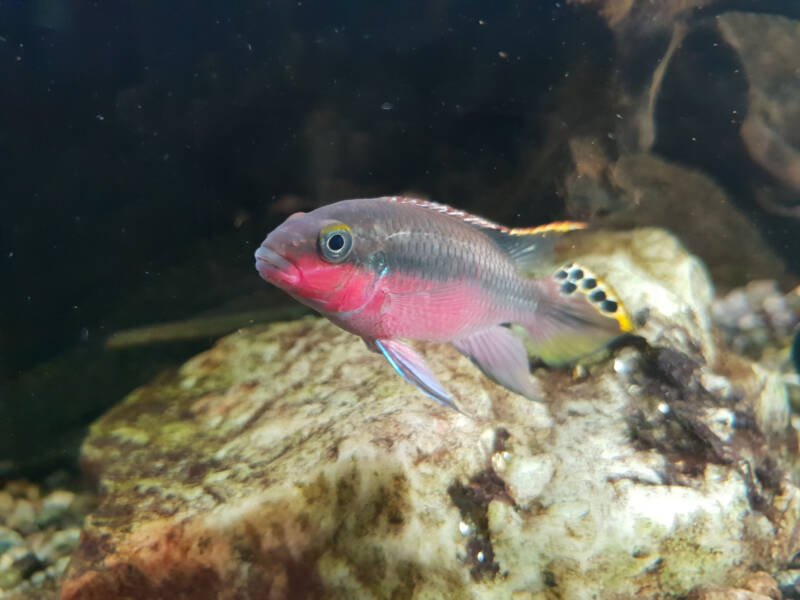
One of the more peaceful cichlid species out there, the kribensis is lively and sociable in a community tank.
While many of the specimens you will find for sale are captive bred, these fish originate in the freshwater coastal regions of Nigeria and Cameroon.
This dwarf cichlid maxes out at four inches (10 cm) for males and three (7.6 cm) for females.
Their upswept dorsal fin and tail are edged with red and yellow, and their bellies are bright red.
While it gets along well with its tank mates, this species is highly protective of its chosen cave, especially when spawning. Do not keep them with other cave-dwelling species.
2. Jewel Cichlid (Hemichromis bimaculatus)
Minimum Tank Size: 40 gallons
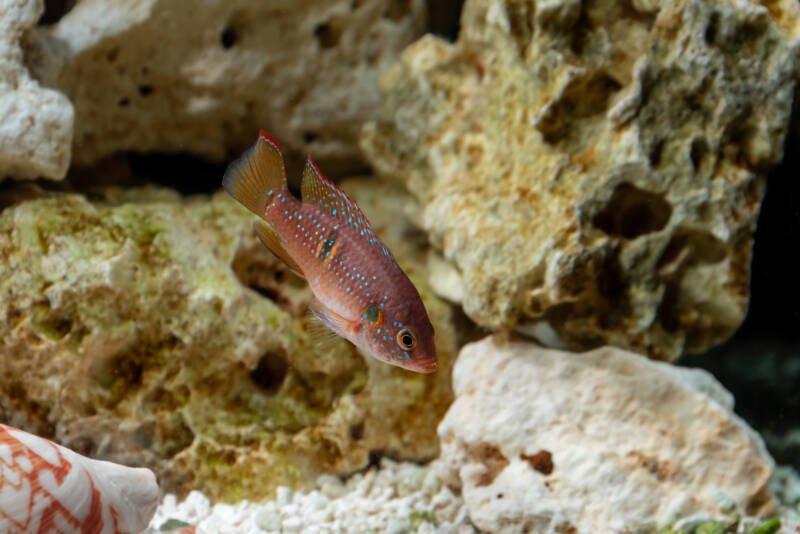
The jewel cichlid is an active species from the western freshwaters of Africa.
The most common color variation has a stunning red/orange body accented with turquoise dots. There is a blue-colored variation as well.
In captivity, these fish reach six inches (15 cm) in length.
The challenge with the jewel cichlid is managing their aggression.
Placing them in too small of an aquarium or one that does not have rocky areas they can claim will significantly increase their stress level, elevate the chance of aggression, and shorten their lifespan.
Feed them well to reduce their tendency to fin nip and consider them for a single-species tank.
3. Frontosa Cichlid (Cyphotilapia frontosa)
Minimum Tank Size: 85 gallons
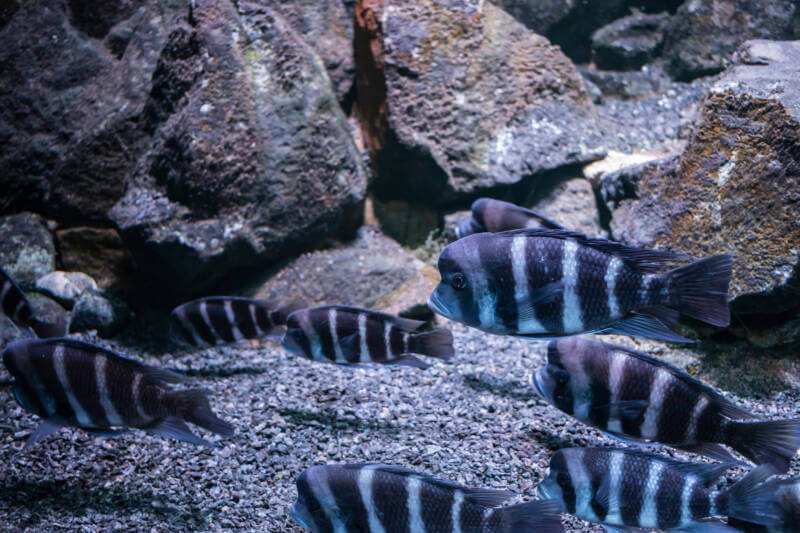
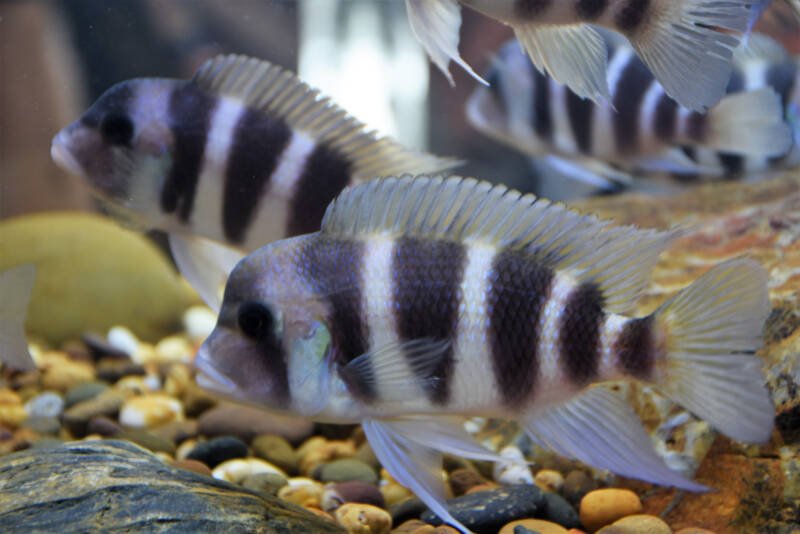
The frontosa cichlid is uniquely shaped with a large hump on its forehead that grows as the fish ages.
They have thick black vertical stripes alternating with light blue- or cream-colored ones. Their dorsal and anal fins sweep gracefully back to a point.
Wild frontosas are only found in Africa’s Lake Tanganyika; most of the aquarium species are captive bred.
Frontosas have lively personalities and will react to their owner in an endearing manner.
These fish can be kept in a group and will form a hierarchy, with the dominant male growing the largest hump.
They are a large species, reaching just short of 14 inches (35 cm) in length as adults.
4. Demasoni Cichlid (Pseudotropheus demasoni)
Minimum Tank Size: 55 gallons
The demasoni cichlid is quite active, with a strong and inquisitive personality.
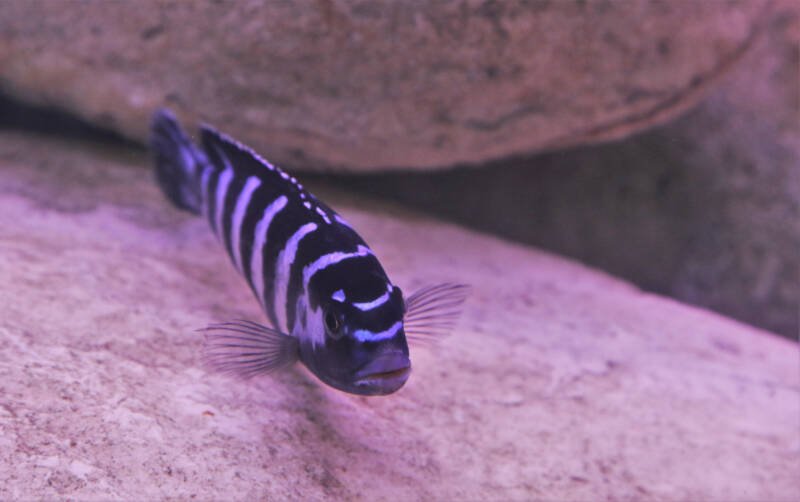
Its body is adorned with vertical black stripes over a gradient range of blue.
This dwarf cichlid stays tiny at an adult length of only three inches (7.6 cm) and thus can live in smaller aquariums.
However, they should be kept in larger groups to bring out their best behavior.
These rock-dwelling fish need such structures in their habitat both for hiding and for snacking on the algae naturally growing on them.
They are omnivores that favor vegetables in their diet.
Demasoni can be aggressive and are challenging to place in a community aquarium. Consider them instead for a single-species tank.
5. Venustus Cichlid (Nimbochromis venustus)
Minimum Tank Size: 125 gallons
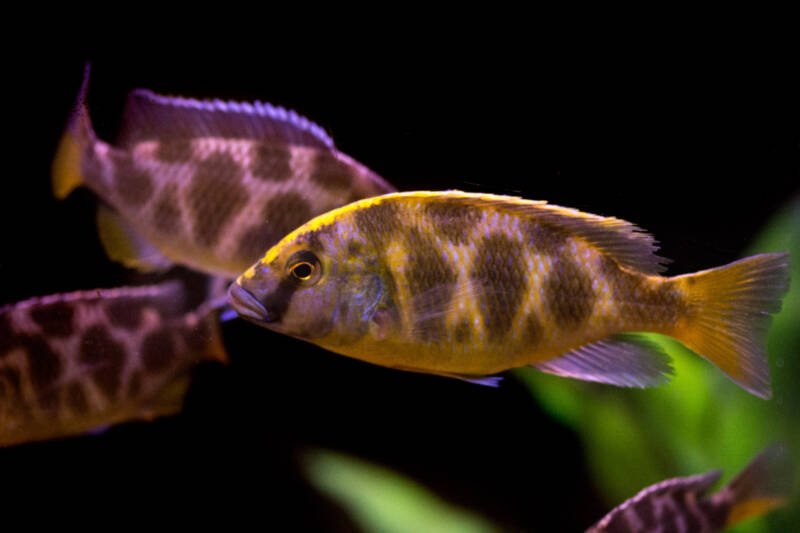
The venustus cichlid is also known as the giraffe fish for a good reason.
One look at their gold/beige patterns will instantly bring their namesake to mind.
Males develop a blue color around their heads as they mature, while females have a darker “giraffe” pattern.
These large fish reach up to 10 inches (25 cm) fully grown and require meat or fish-based diet.
Venustus are surprise predators that will burrow into the substrate and remain still to ambush their prey.
Their favorite prey are smaller fish, and while their personality is perfect for a community tank, do not pair venustus with small species and only keep one male in the tank.
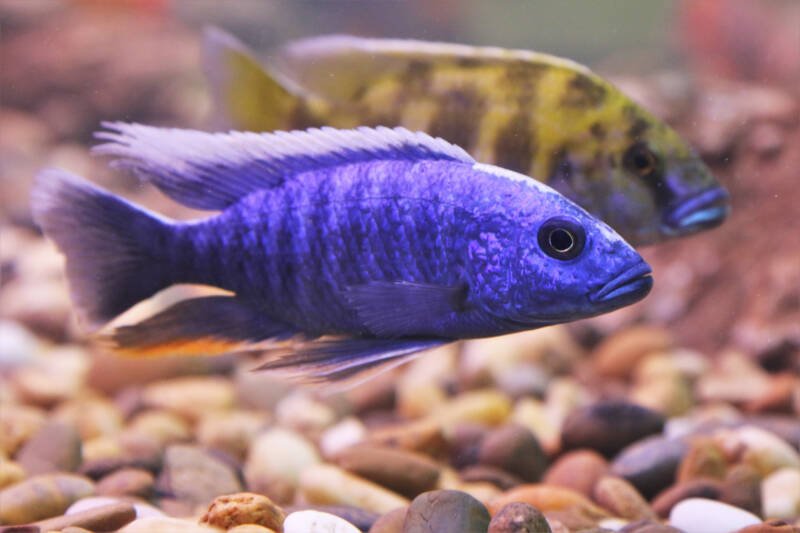
6. Electric Blue Cichlid/Electric Blue Hap (Sciaenochromis fryeri)
Minimum Tank Size: 70 gallons
The electric blue hap is a brightly colored member of the Haplochromis group of cichlids.
The males are a vibrant blue and grow slightly larger, while the females tend to be silver to pale blue.
They reach around six to 6.5 inches (15 to 16.5 cm) in length and are capable hunters.
This omnivore favors meaty foods, such as bloodworms, brine shrimp, and even smaller fish.
Avoid pairing them with smaller species it may view as food, and consider breeding your own feeder fish to satisfy your electric blue’s needs.
Keep only one male in your tank to avoid hierarchical and territorial aggression.
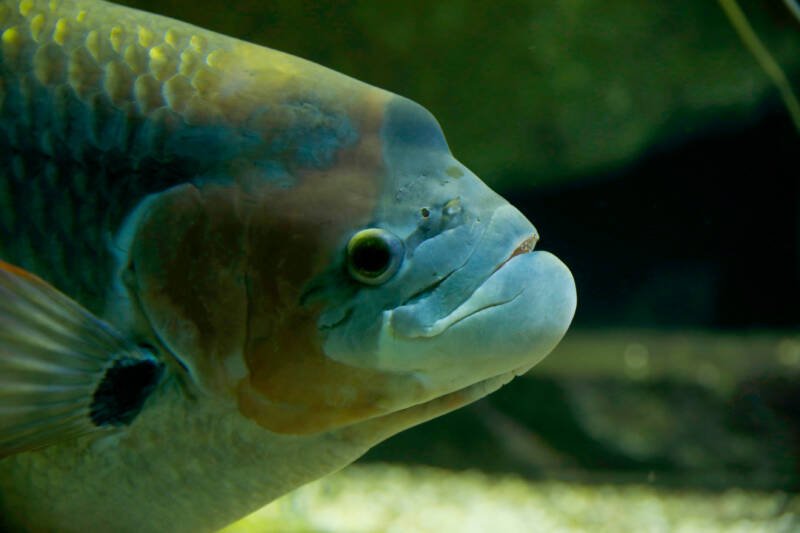
7. Lionhead Cichlid (Steatocranus casuarius)
Minimum Tank Size: 30 gallons
When you first observe the lionhead cichlid, you may be surprised by its odd swimming behavior.
Native to fast-moving streams, this fish skims the substrate as an adaptation to conserve energy.
This habit, along with its reduced swim bladder size, does not result in a champion swimmer.
Both sexes of this species stay small, with the males reaching 4.5 inches (11 cm) and the females two inches (5 cm) fully grown.
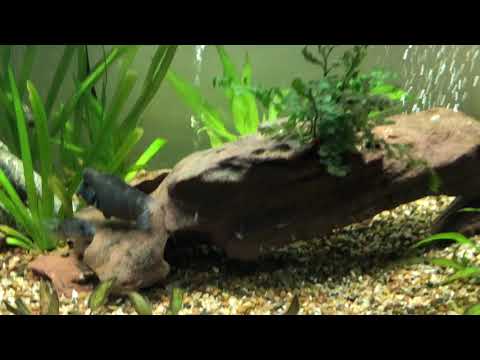
Males develop a prominent nuchal hump. These fish form bonded pairs that will not accept others of their kind into their space.
They can be placed with other cichlid species.
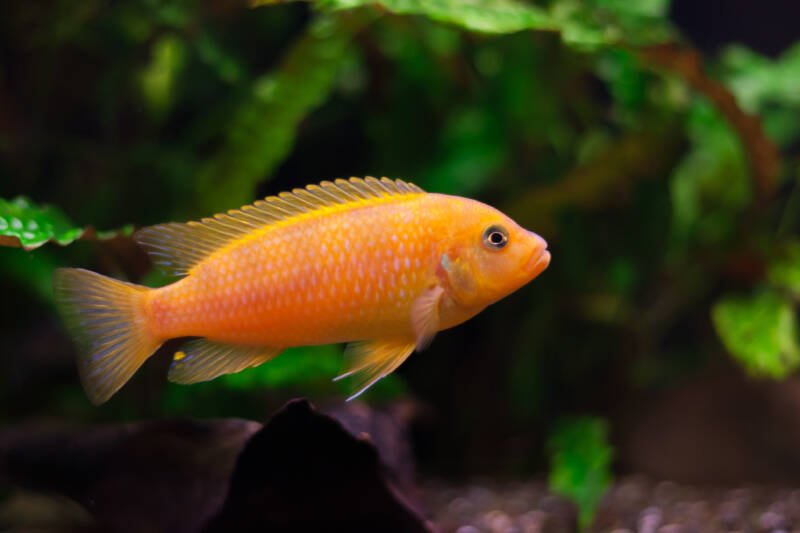
8. Kenyi Cichlid (Metriaclima lombardoi)
Minimum Tank Size: 75 gallons
As juveniles, both sexes of kenyi cichlids have alternating light and dark blue bands.
As they mature, however, the males develop a brilliant yellow/orange coloration. The colors compliment each other wonderfully, making for a beautiful display.
Interestingly, the females of this mouthbrooding species change their coloration to match the males’ when breeding.
Beauty aside, these fish are extraordinarily territorial and require a well-informed aquarist to mitigate their aggression through a properly designed layout, appropriate stocking limits, and a regular feeding regimen.
These fish reach an adult length of six inches (15 cm) and are herbivores that need high-quality vegetable flake or pellet foods.
9. Red Empress Cichlid (Protomelas taeniolatus)
Minimum Tank Size: 75 gallons
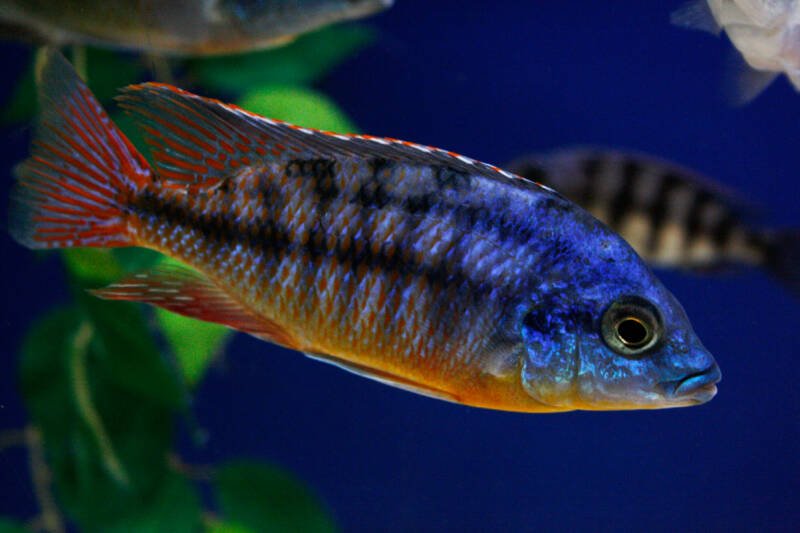
Bringing both beauty and an appealing temperament, the red empress cichlid is an excellent choice for a home aquarium.
Colors vary from fish to fish and location of origin, but in general, the males are a vibrant red-orange color and can also be gold or blue.
They can reach anywhere between 4.5 to six inches (11 to 15 cm) in length.
These fish are quite easy to care for when given a good-sized tank and steady, alkaline water conditions.
They like to stick close to rocks, need a soft sandy substrate, and will not pick at live plants, should you include them in your aquarium.
Do not house multiple males together and limit the number of other species in the tank.
10. Acei Cichlid (Pseudotropheus acei)
Minimum Tank Size: 55 gallons
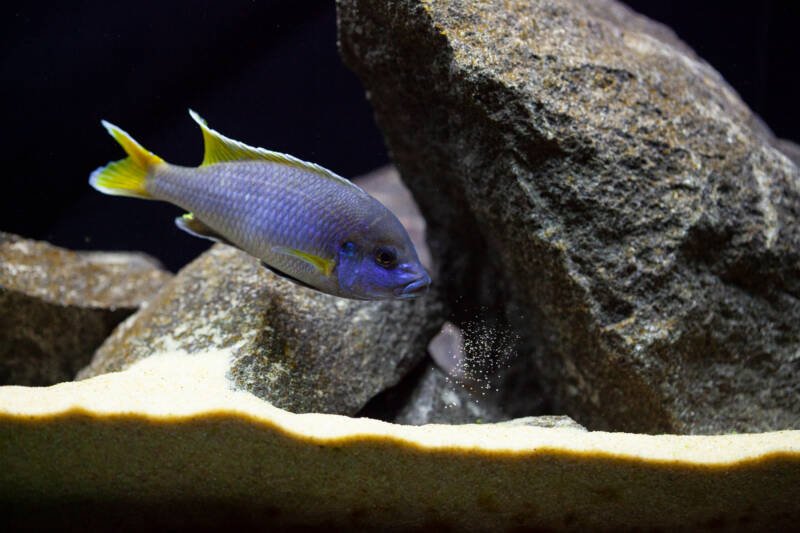
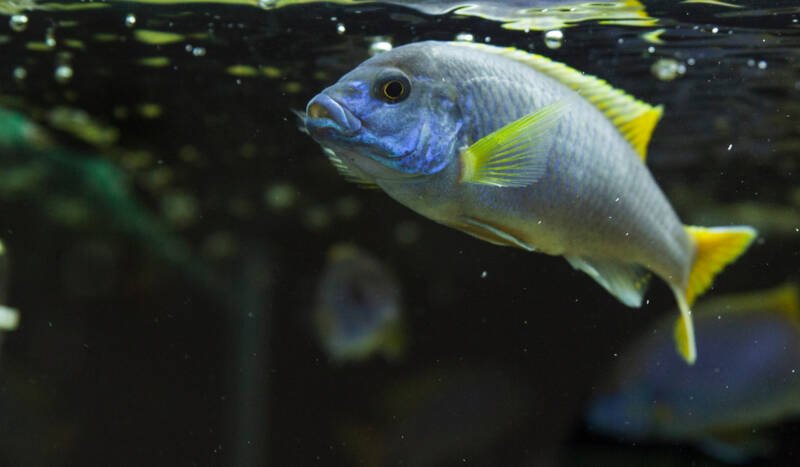
Acei cichlids are a light shade of blue with a yellow tail and dorsal fin. A less common color morph has a white tail.
Adult fish can reach anywhere between four to seven inches (10 to 18 cm) in length with the males being larger than the females.
As young fish, acei are peaceful and can be kept in a community tank, where they will bring color and activity to all levels of the water column.
Just make sure they are not placed with larger, predatorial fish or you may find your population decreasing.
As these fish age, however, they can become territorial, aggressive, and nippy.
11. Red Zebra Cichlid (Maylandia estherae)
Minimum Tank Size: 50 gallons
Red zebras can be challenging for those new to keeping cichlids, with the biggest challenge being their behavior.
These fish are highly territorial and will show equal aggression toward other species and their own kind.
This behavior is the same regardless of whether they are in breeding season.
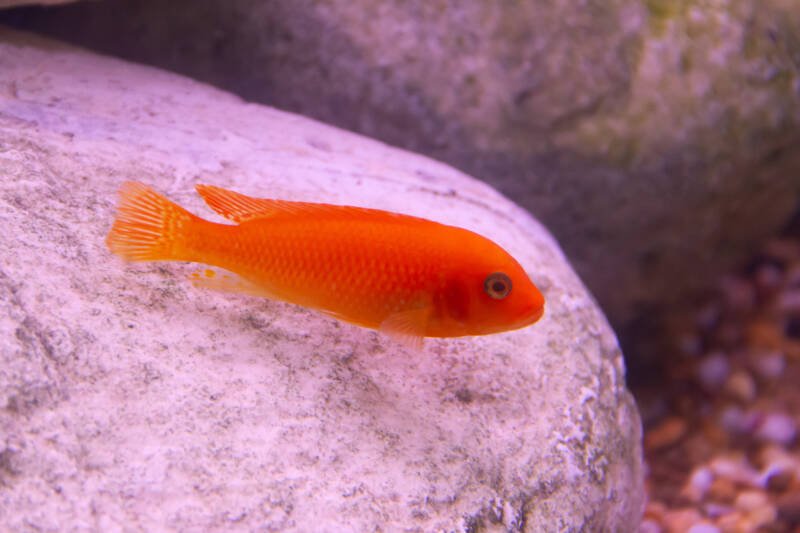
Oddly, the coloration of these fish does not match their name. They are a beautiful yellow color with distinct egg spots on their anal fin.
They grow to a reasonable adult size of five inches (13 cm) and do best in a tank with plenty of rock structures.
Go easy on plants or consider no vegetation as red zebras tend to nibble the leaves and uproot them.
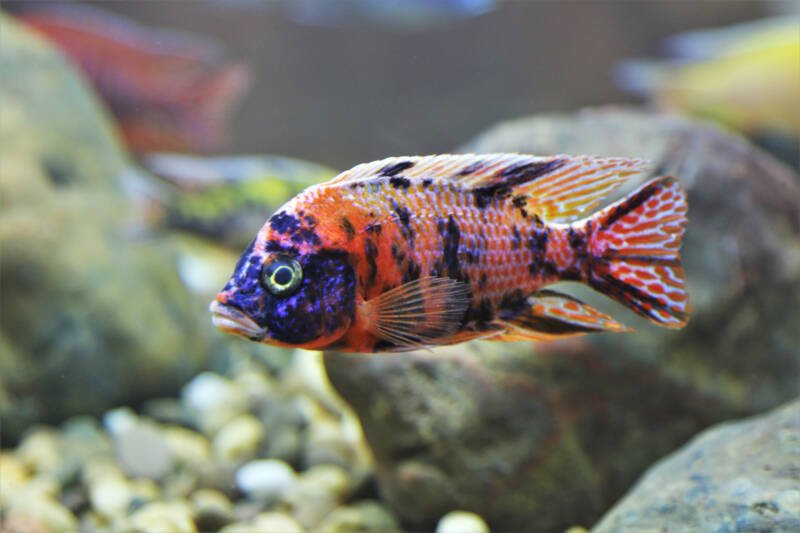
12. Ob (Peacock) Cichlid (Aulonocara sp.)
Minimum Tank Size: 75 gallons
Ob cichlids are hybrids created from a cross of a male Aulonocara with a female mbuna.
They have elegant spotted patterns and can appear in red, blue, orange, or yellow. The patterns vary from fish to fish, and the males display the brightest colors.
Feed these carnivores a meat-based cichlid pellet supplemented with live or frozen foods.
While they are easygoing fish, the males can be aggressive toward other males of their kind.
They grow to six inches (15 cm) in length and can pair with similarly sized fish.
Be aware that these fish can interbreed with other Aulonocara, so avoid placing them in the same tank.
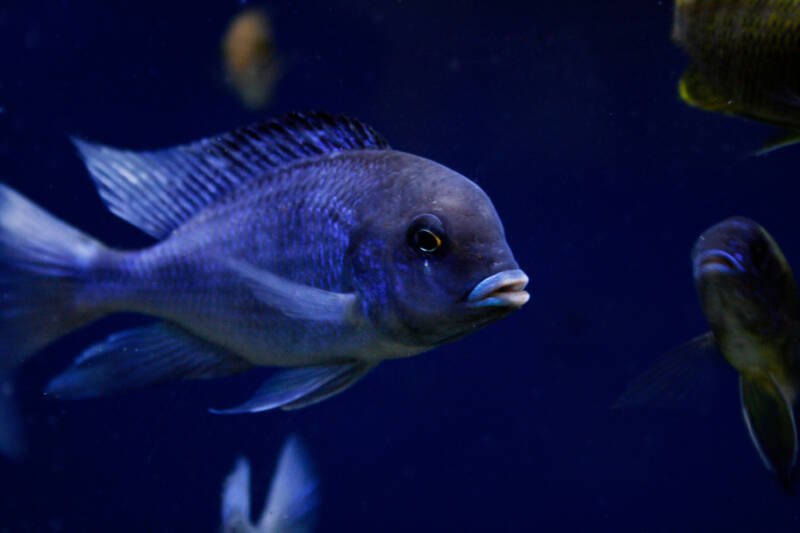
13. Blue Dolphin Cichlid (Cyrtocara moorii)
Minimum Tank Size: 75 gallons
With its startling blue color, raised forehead, and oversized lips, the blue dolphin cichlid is a unique addition to a home aquarium.
These are larger cichlids and reach up to 10 inches (25 cm) in length as adults.
All cichlids need solid upkeep on their water conditions; however, the blue dolphin is susceptible to vision problems if their water is substandard.
These fish do well in a community tank with other Malawi cichlids and are easygoing in temperament except when breeding.
Place them with fish of equivalent size as these omnivores will hunt down smaller fish.
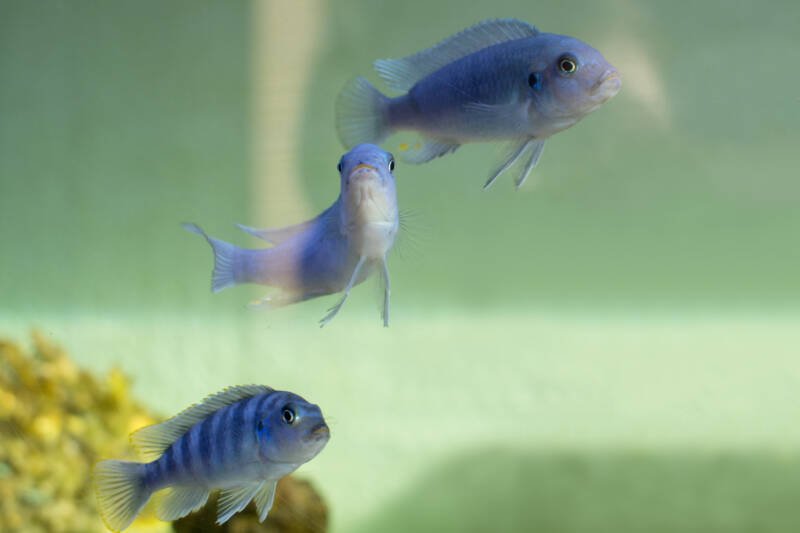
14. Sokolofi/Socolofi Cichlid (Pseudotropheus socolofi)
Minimum Tank Size: 40 gallons
This native of Lake Malawi is a muted blue color with contrasting black-tipped fins and a black stripe crossing the eye.
This smaller species stays between four to 4.6 inches (10 to 12 cm) and does not require a large aquarium.
They need a good mix of open swimming space and rocky hiding places to be comfortable.
Sokolofi cichlids are best kept in groups with a higher ratio of females to males.
This species establishes a group hierarchy, so take care to not isolate a fish from the group for an extended period.
Increase the tank size if you are keeping more than one male and do not house these fish with larger or more aggressive cichlids.
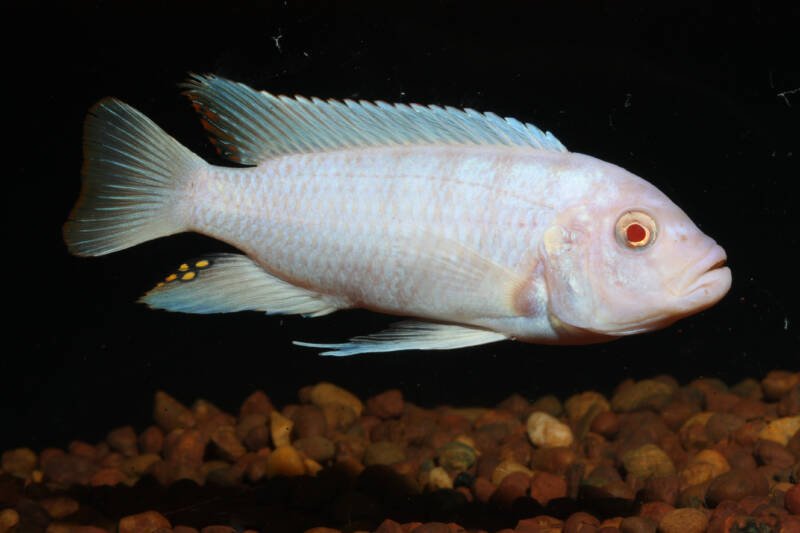
15. Snow White Cichlid (Pseudotropheus socolofi, albino)
Minimum Tank Size: 40 gallons
The snow white cichlid is a specifically bred color variant of the blue pindani (Pseudotropheus pandani), or powder blue cichlid.
It is a peaceful omnivore whose white coloration (with a slight blue tint) is even over the body, head, and fins.
It has red eyes, and males will feature yellow egg spots on their anal fins.
Keep at least two to three females per male and only have one male per aquarium to keep aggression down.
They can live in a community tank with other species capable of looking out for themselves.
The snow white’s diet is heavy on the vegetable side, but they need a mix of both vegetables and meaty foods to be healthy.
16. Strawberry Peacock Cichlid (Aulonocara sp.)
Minimum Tank Size: 50 gallons
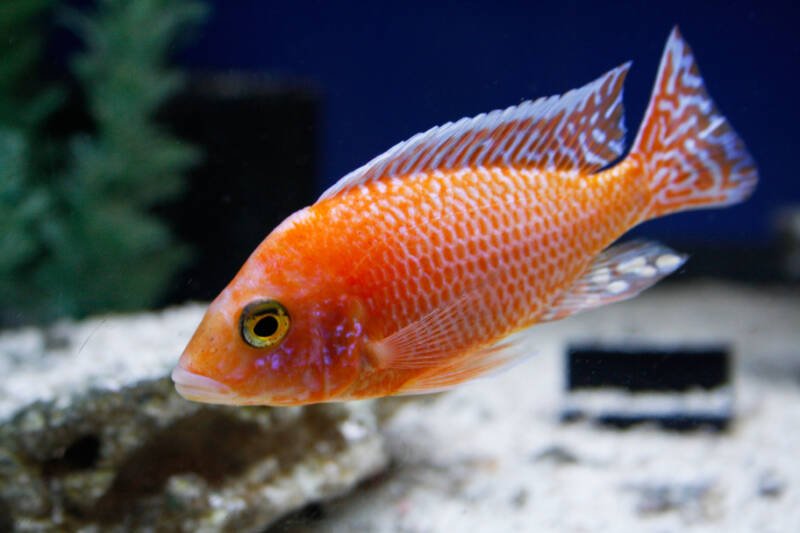
Strawberry peacock cichlids are a gentle red/pink, orange, and white color.
The blotchy pattern covering their body and extending through the fins, when combined with this coloration, gives the impression of a strawberry.
Males tend to have brighter colors than females.
This six-inch-long (15 cm) fish has a pleasant personality but can become territorial when spawning.
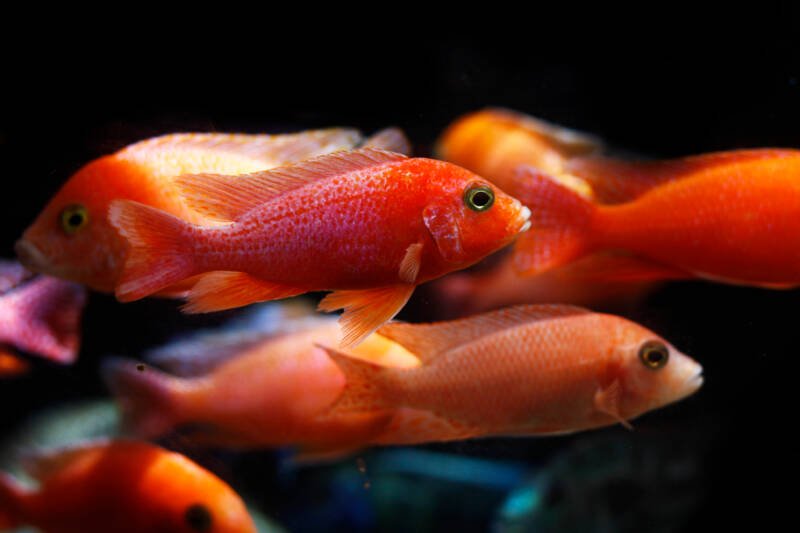
They are carnivorous and love to hunt live prey. Do not place them in a community tank with smaller fish that may be viewed as food.
They will also take frozen foods, such as bloodworms and brine shrimp, in addition to standard pellet foods.
17. Duboisi Cichlid (Tropheus duboisi)
Minimum Tank Size: 75 gallons
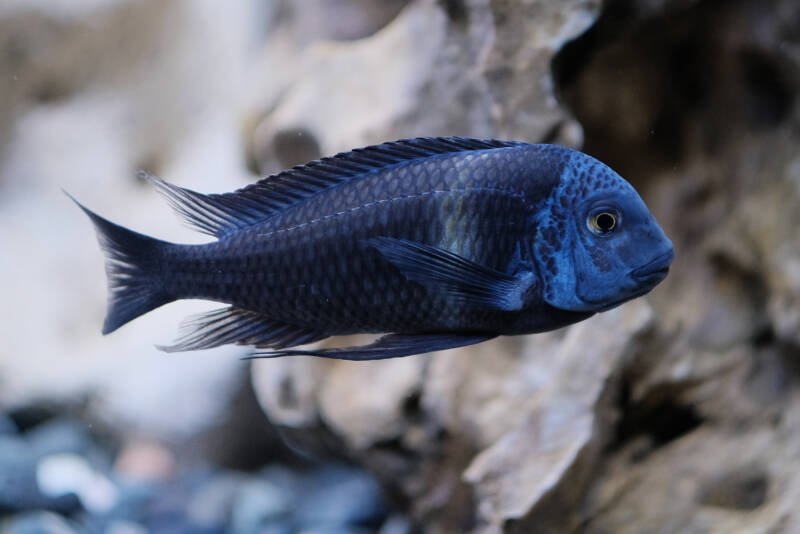
If you get your duboisi cichlid young, you will enjoy the color transformation they undergo as they mature.
Juvenile fish are black and covered with white dots. As adults, their color morphs into a blueish head, dark body, and a contrasting band just behind the pectoral fin.
Depending on where the fish comes from, the band can be white or yellow and broad or thin.
They reach a manageable adult size of five inches (13 cm).
These fish are highly aggressive and should not be housed with passive species or with more than one male.
Remember that native populations are listed as vulnerable on the IUCN Red List, so seek out captive bred specimens.
18. Golden Mbuna Cichlid (Melanochromis auratus)
Minimum Tank Size: 55 gallons
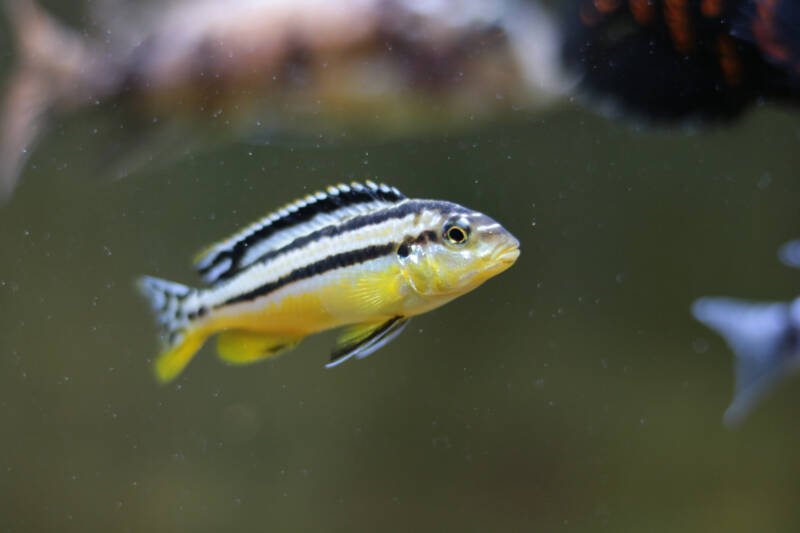
Another Lake Malawi native, the golden mbuna is true to its name with a stunning golden color accented by black and white horizontal stripes.
These stripes even appear along the dorsal fin, completing an already sleek look.
It stays on the small side, reaching only 4.4 inches (11 cm) as an adult.
Despite its small size, a moderately sized tank is required to keep this fish due to its higher aggression.
They are extraordinarily territorial and develop a pecking order within their group.
Keep only one male per tank and do not house them with peaceful fish or those with a similar color pattern.
19. Star Sapphire Cichlid (Phenochilus tanzania)
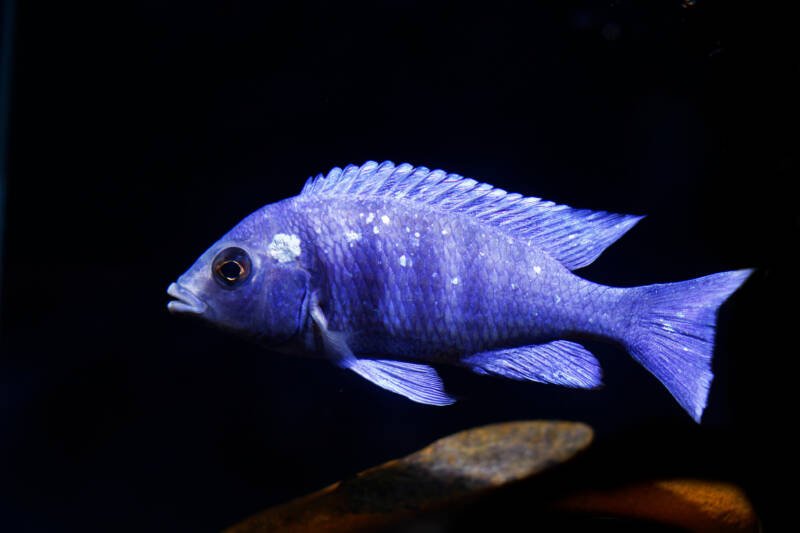
Minimum Tank Size: 75 gallons
Shimmering with dappled shades of blue and turquoise, the star sapphire cichlid immediately draws the eye.
They achieve their full coloration anywhere from two to three years of age and reach an adult length of 10 inches (25 cm).
Males start out as a deep blue, developing unique spotted patterns as they age. Females stay smaller, around six inches (15 cm), and are colored silver with black bands.
They are peaceful in nature, showing mild territorial aggression among males during breeding times.
Star sapphires are easy to feed. These carnivores accept a wide variety of live or frozen foods as well as cichlid pellets.
20. Livingston’s Cichlid (Nimbochromis livingstonii)
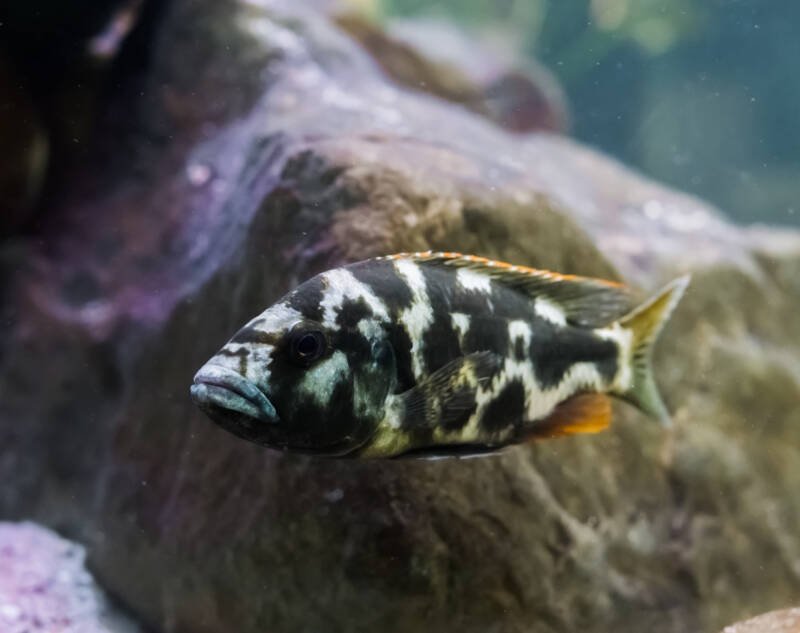
Minimum Tank Size: 125 gallons
Even though the Livingston cichlid reaches a sizable 10 inches (25 cm) in length, its dappled silver and grey color provides perfect camouflage for this adept hunter.
In fact, this fish’s unique hunting tactic makes for fun observation.
The Livingston will remain on its side on the substrate for an extended period, waiting for a fish to swim near it. It then quickly snatches its prey.

Avoid housing this fish with highly active species or with those that are small (the Livingston is a predator, after all).
They are peaceful with their own kind and are best in a group with one male and three to four females.
21. Fairy Cichlid/Lyretail Cichlid (Neolamprologus brichardi)
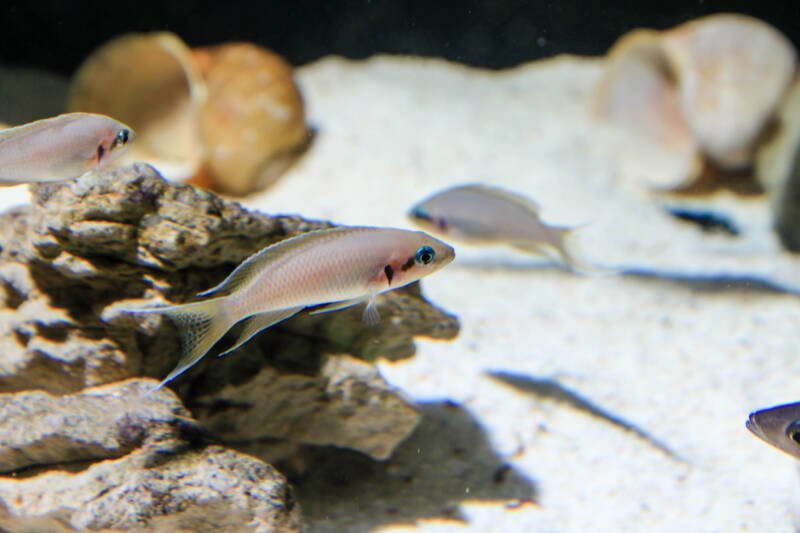
Minimum Tank Size: 20 gallons
The fairy cichlid is another species that loves to explore piles of rocks in its habitat and happily occupies the middle to upper levels of the water column.
They are a lovely pearl color with sweeping dorsal and caudal fin extensions.
The males are larger than the females and have longer extensions.
Fairy cichlids stay small, reaching only between 2.8 to 3.5 inches (7 to 9 cm) in length as adults.
Their personality is mild enough to allow them to live in community tanks; however, they can be territorial with their own kind and any similar-looking fish.
Fairy cichlids favor a variety of meaty foods but need some vegetable offerings from time to time.
22. Blue Peacock Cichlid (Aulonocara nyassae)
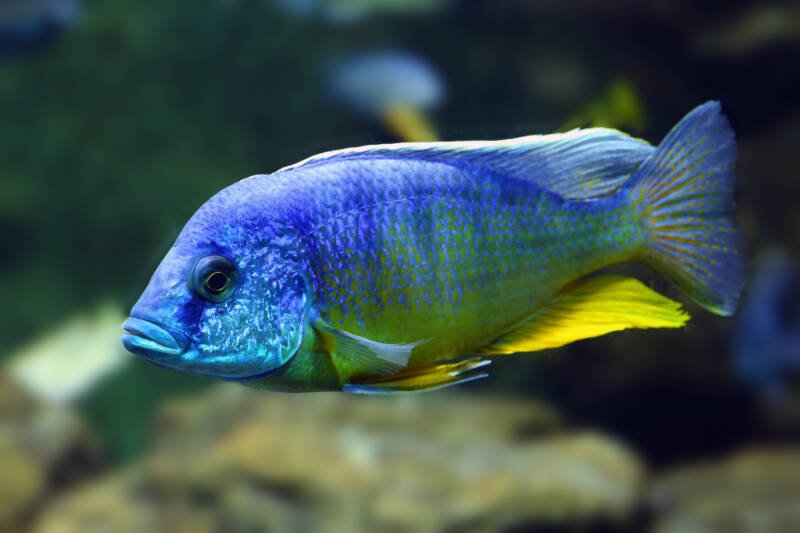
Minimum Tank Size: 55 gallons
The blue peacock cichlid is another stunningly blue-colored fish from Lake Malawi.
As with many other cichlid species, the male dons the brightest colors. Females are a brown-grey color.
They reach an average length of seven inches (18 cm) fully grown and are easy to care for.
These fish prefer meaty foods but will also take vegetables from time to time.
Males display a yellow color during breeding times, which is when you need to watch for aggression.
Providing a group of three to four females per male along with ample hiding places can help with mitigation.
23. Sunshine Peacock Cichlid (Aulonocara stuartgranti)
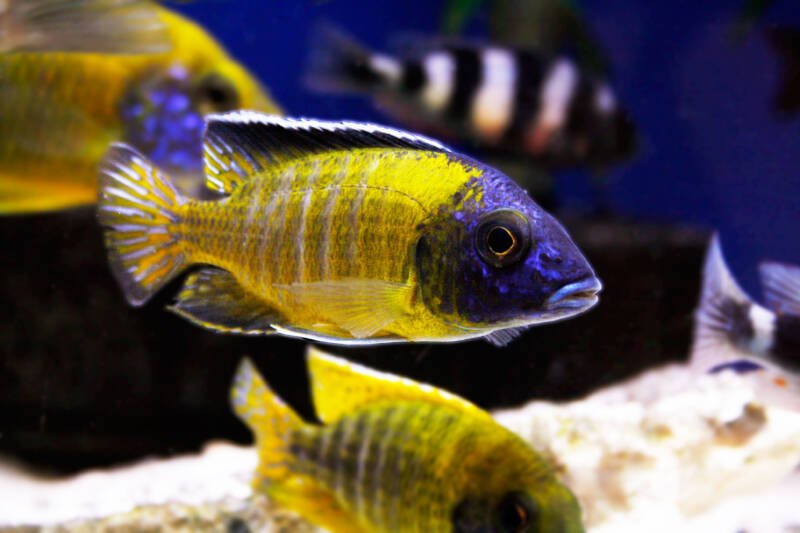
Minimum Tank Size: 75 gallons
There is no denying the appeal of the sunshine peacock cichlid’s lemon-yellow body and sparkling blue face.
This fish not only boasts good looks, but it also has an amenable personality.
Males reach up to seven (18 cm) inches in length while females are closer to five (13 cm).
They are active fish that enjoy swimming among decorations in the tank and sifting through the sand.
While they occasionally may squabble over a bit of territory with their tank mates, their level of aggression is far lower than other cichlid species.
Males can occasionally come into conflict if there are more males than females in the tank.
24. Shell Dwelling Cichlid (Neolamprologus multifasciatus)
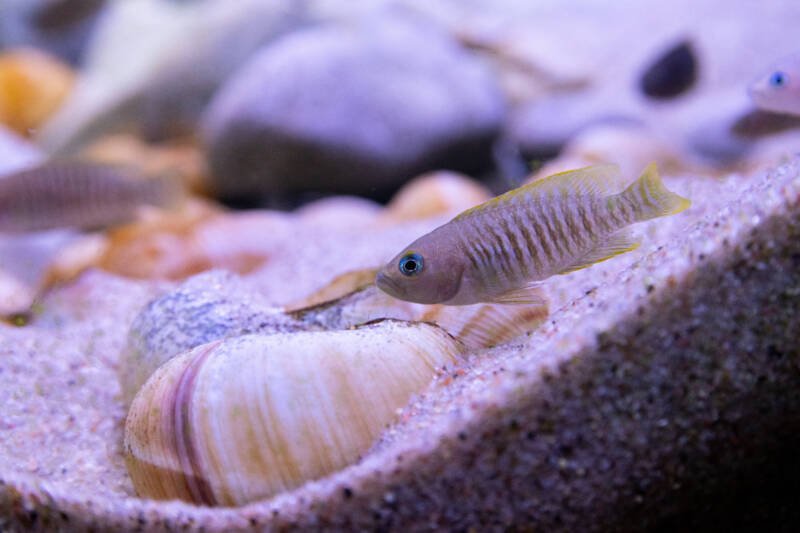
Minimum Tank Size: 10 gallons
The “awwww” factor is high with the tiny shell-dwelling cichlid.
These fish inhabit discarded shells along the bottom of Lake Tanganyika – living and even breeding therein.
Males reach a maximum length of two inches (5 cm), whereas females grow to a diminutive one inch (2.5 cm).
Shell-dwellings have zebra stripe banding, an upturned mouth, and large eyes.
These fish benefit from a longer tank as they stay near the bottom.

Scatter anywhere from two to six shells per fish and watch as they select their favorite.
They can be slightly territorial with their shells but have an easygoing personality among their own.
Do not place them with larger fish that may consider them food.
25. Johanni Cichlid/Bluegray Mbuna (Melanochromis johannii)
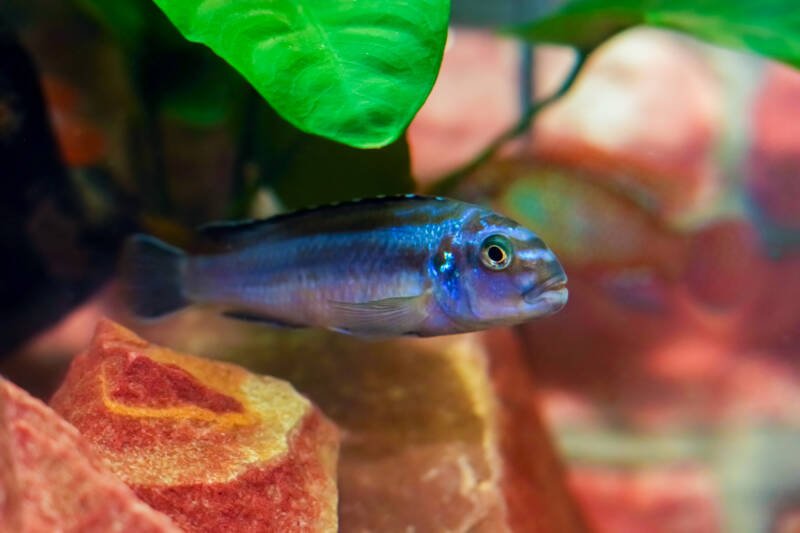
Minimum Tank Size: 30 gallons
With the johanni cichlid, it is simple to distinguish the male from the female. Females are a vibrant yellow-orange in color, while males are bright blue with broken, horizontal dark stripes.
They are also a small species, only reaching three inches (7.6 cm) fully grown.
These fish can live in a single species aquarium with a single male and multiple females.
Johannis can also exist in a community tank with similarly sized, easygoing fish as long as they do not resemble the johanni in shape or color.
Avoid housing them with other Melanochromis species as unwanted interbreeding or aggression can occur.
26. Maingano Cichlid (Melanochromis cyaneorhabdos)
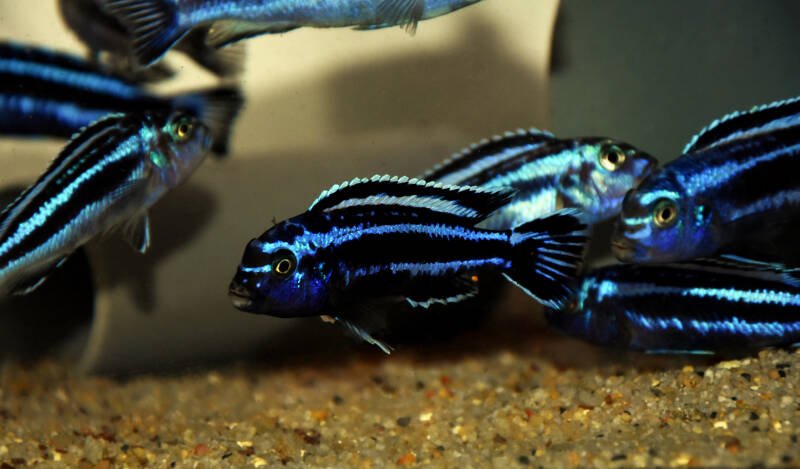
Minimum Tank Size: 55 gallons
Maingano cichlids have similar coloration to male johanni cichlids, with their blue color and horizontal stripes.
For the maingano, however, the stripes are solid as opposed to the johanni’s broken ones.
These fish grow to a reasonable four inches (10 cm) in length, so tank size is manageable.
They are easy to feed and need predominantly vegetable foods with meaty foods as a supplement.
Their natural habitat is below rocky shorelines, with highly oxygenated water.
Males aggressively guard their selected territory among the rocks and typically are in the company of a group of females. A home aquarium should replicate these conditions.
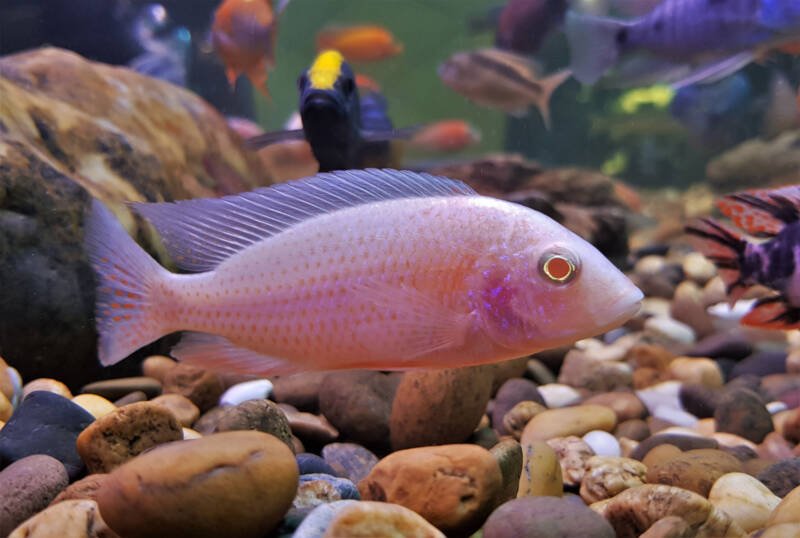
27. Albino Peacock Cichlid (Aulonocara sp.)
Minimum Tank Size: 55 gallons
Albino peacock cichlids are fish that have been purposefully bred for their coloration.
They appear in pale red and white on the body and fins and have red eyes.
They are five inches (13 cm) long as adults and have a good temperament.
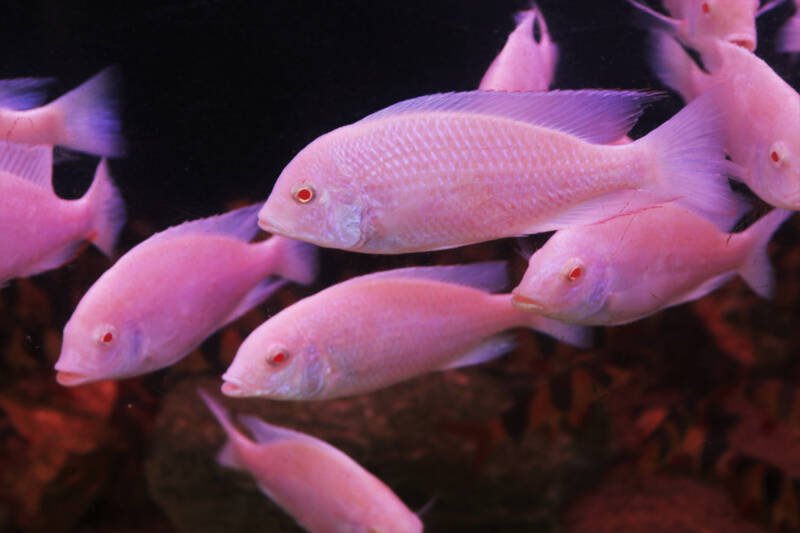
Males can be aggressive toward each other and toward other species that happen to invade their territory. Otherwise, they get along well with their tank mates and are ideal for a community tank.
These omnivorous fish are incredibly easy to feed and accept a wide variety of live, frozen, and pellet foods.
Make sure they get both meaty and vegetable foods for optimum health.
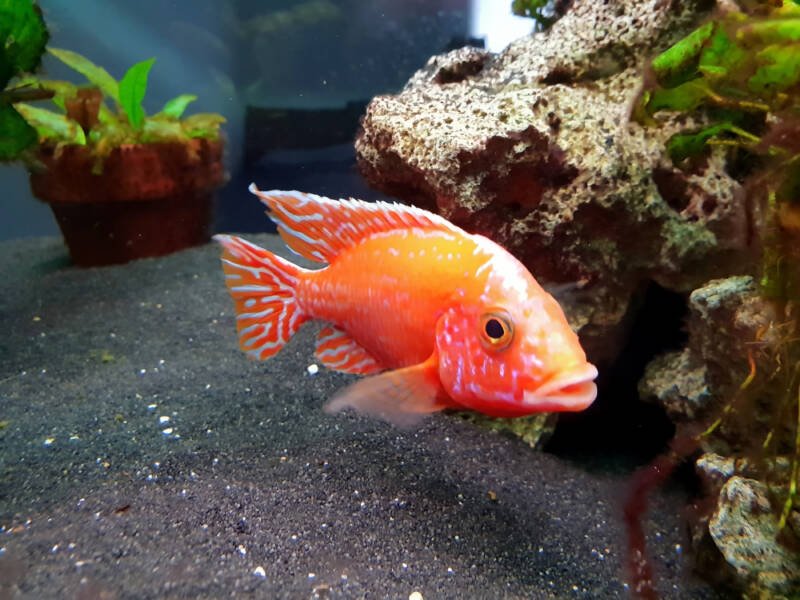
28. Dragon Blood Peacock (Aulonocara sp.)
Minimum Tank Size: 50 gallons
Another color variation of the peacock cichlid is the dragon blood.
This hybrid fish features speckled red, orange, and pick coloration along its entire body, head, and fins. Touches of blue and white streak through the fins of this six-inch-long (15 cm) fish.
Also known as the firefish, the dragon blood peacock is mild-mannered and can get along with multiple other species in a community tank.
The only time you may see increased aggression is during breeding times.
Even then, it is usually restricted to other males or other Aulonocara species.
These omnivores will eat just about anything you throw at them but need variety to bring out their best colors.
29. Emperor Cichlid (Boulengerochromis microlepis)

Minimum Tank Size: 300 gallons
Roll out the biggest of tanks for the giant emperor cichlid. Reaching a whopping size between 30 to 36 inches (76 to 91 cm) in length, these fish require an aquarist expert in the upkeep of large tanks.
They are less colorful than some of the other cichlids listed here but still feature a range of grey, green, and yellow colors with large, dark spots along the midline.
These fish are omnivores that will readily go after any smaller species it views as food.
While they are not particularly aggressive, they can become territorial, and a tank setup should allow each fish to establish a personal space.
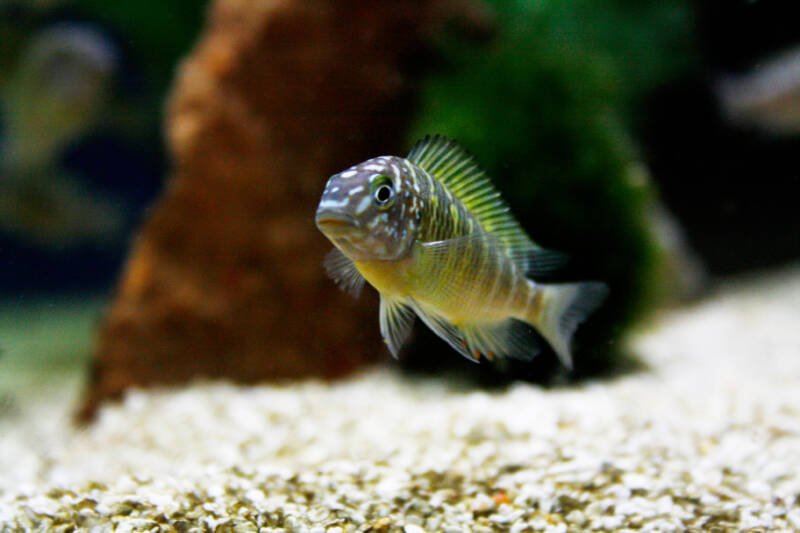
30. Tropheus Cichlid (Tropheus moori)
Minimum Tank Size: 75 gallons
Active, playful, and with over 50 color morphs from which to choose, the tropheus cichlid truly has much to offer.
These long-lived fish can beautify your tank for up to 10 years as they explore all levels of the water column.
Due to their high activity level and a tendency toward territorial aggression, they require a large tank for a fish that only reaches 5.75 inches (14.6 cm) in length.
These fish are omnivores with a heavy emphasis on the vegetables.
They do well in a single species tank with one or two males and several females.
Avoid placing them with slow swimming fish or slow eaters as the tropheus will easily outcompete them for food.
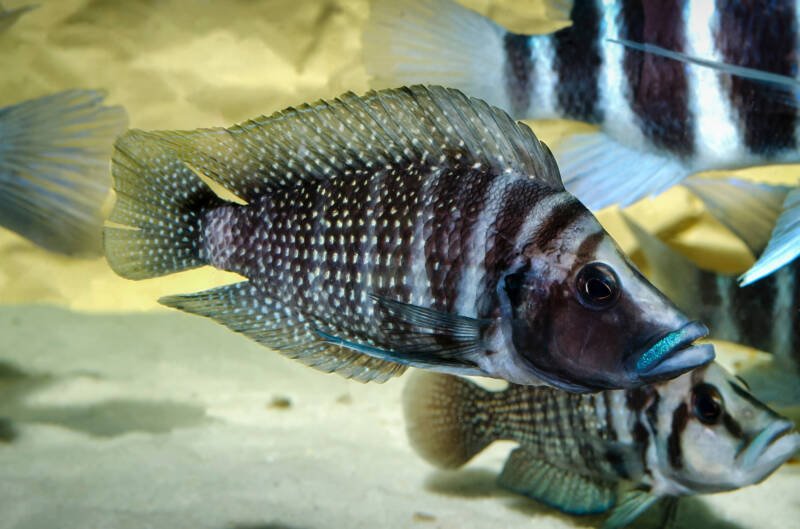
31. Calvus Cichlid (Altolamprologus calvus)
Minimum Tank Size: 20 gallons
Depending on which part of Lake Tanganyika your calvus comes from, they may be colored black, white, or yellow.
They have dark vertical stripes and are speckled from gills to tail fin with small white dots.
These predators reach a maximum size of six inches (15 cm), need meaty foods in their diet, and will typically only accept live or frozen foods.
Calvus cichlids are on the shy side, so avoid placing them with overly aggressive fish.
Include plenty of hiding places and keep the lighting dim.
Their gentle personality makes them excellent additions to a single species or community tank.
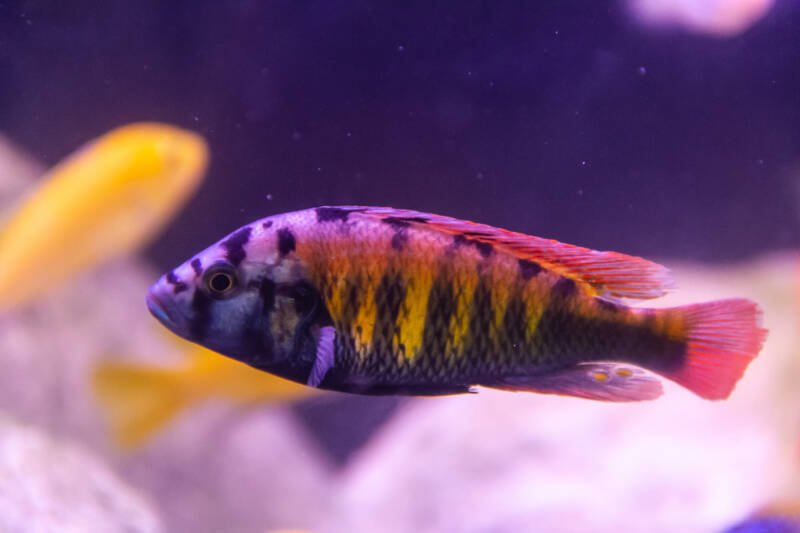
32. Flameback Cichlid (Haplochromis xystichromis)
Minimum Tank Size: 40 gallons
The flameback cichlid is a brightly colored native of Lake Victoria.
They have a yellow base color, darker vertical stripes, and a bright red patch extending down their back.
These fish reach six inches (15 cm) in length as adults and are an attentive, mouthbrooding species.
Flameback cichlids prefer to stick to the rocks, so an aquarium should emphasize rocks over open space. This will also help to break the line of sight and reduce aggression among males.
The most peaceful setup will have multiple females for each male in the tank.
These omnivores need a diet heavy with vegetables and the occasional meaty treat.
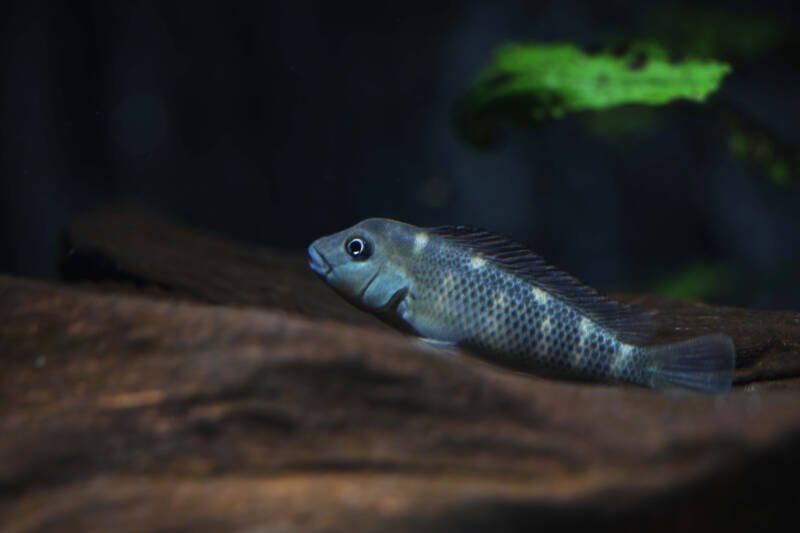
33. Buffalo Head Cichlid (Steatocranus casuarius)
Minimum Tank Size: 50 gallons
What the buffalo head cichlid lacks in flashy colors, it more than makes up for with its unique head shape, pouty lips, and expressive upward turned eyes.
It also has an interesting, rather jerky, swimming method adapted to life in its native quick-moving waters.
Buffalo head cichlids have a mild temperament and are suitable for a community aquarium.

Some aggression may occur between males vying for dominance. Include multiple cave features or rock structures that the fish can claim as territories.
These fish will reach around 4.5 inches (11 cm) fully grown and require high oxygenation and strong water movement in their tank.
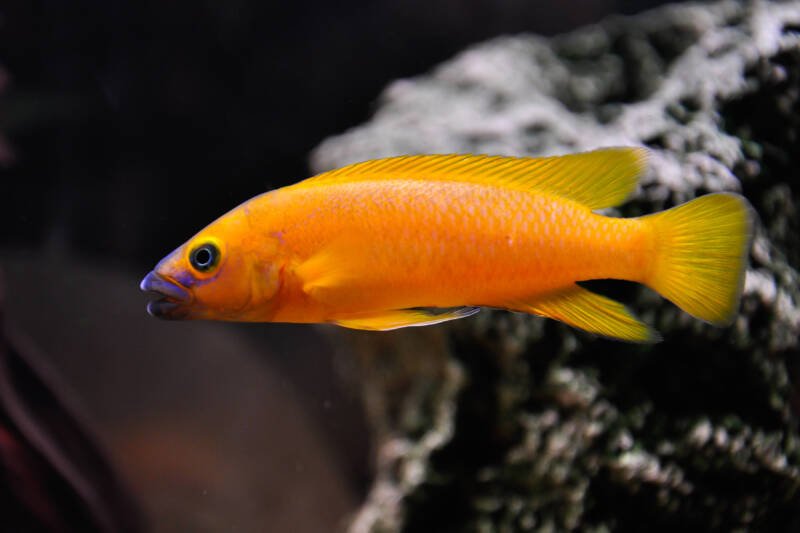
34. Leleupi Cichlid (Neolamprologus leleupi)
Minimum Tank Size: 20 gallons
If you want to add a pop of color to your aquarium, the leleupi cichlid will certainly do it.
The aptly nicknamed lemon cichlid is a brilliant shade of yellow extending throughout its body and fins.
While this fish gets along well with its tankmates, provided they are not overly boisterous species, they are aggressive toward their own kind.
They stay small, at a maximum length of four inches (10 cm), and thus require a smaller aquarium.
Do not skimp on the rockwork, as these fish prefer the safety these spaces provide.
Their omnivorous diet leans toward the meaty side, and they should receive mostly live or frozen foods as they do not favor dried foods.
35. Daffodil Cichlid (Neolamprologus pulcher)
Minimum Tank Size: 15 gallons
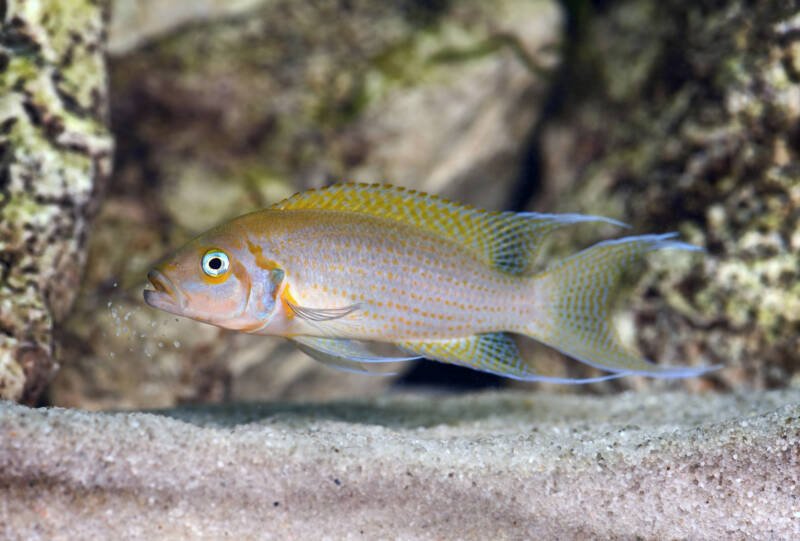
Daffodil cichlids are an excellent choice for the beginning aquarist. They are peaceful in nature, hardy, and easy to feed.
Their slender body is topped with a graceful dorsal fin and ends in a lyre-shaped tail.
Their bodies are yellow with hints of blue, and they have lovely blue eyes.
Daffodils enjoy all aspects of the aquarium, from resting in the rockwork to swimming in the open space, making them a fun and active addition.
This schooling species loves to be in a group of its own kind.
They pair off and breed frequently, using sheltered spaces within the tank to spawn. They can get slightly territorial during these times.
36. Rusty Cichlid (Lodochromis sprengerae)

Minimum Tank Size: 20 gallons
The rusty cichlid is a smaller species, maxing out at four inches (10 cm).
Nevertheless, its color and delightful personality steal the show.
Juveniles start out with an orange color that morphs to a beautiful red-orange, blue, and purple as the fish matures.
They need a well-planted tank with sturdy plants.
These are peaceful fish that tolerate others well outside of breeding times. Avoid placing them with more aggressive species, as the rusty cichlid will often come out on the losing side of any confrontation.
Their personable nature is appealing. They will react to their owners and can be trained to be hand-fed.
37. Starry Night Cichlid/Polleni Cichlid (Paratilapia polleni)
Minimum Tank Size: 120 gallons
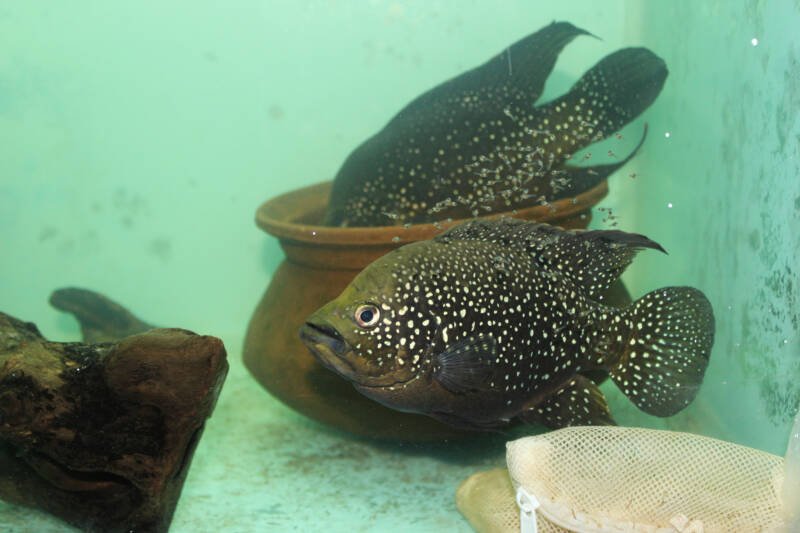
Vibrant blue-white “stars” dot the inky landscape of the starry night cichlid.
This sizable fish comes from the freshwaters of Madagascar and grows to an adult length between 10 to 12 inches (25 to 30 cm).
They are highly aggressive and should only be kept with large, similarly tempered fish in a tank large enough to accommodate their territorial nature.
A well-planned tank that breaks up the line of sight will allow for multiple fish to be kept.
The IUCN Red List notes the vulnerability of this species. Therefore, seek out captive-bred specimens to protect remaining wild populations.
These fish can live from 10 to 13 years with diligent care, so plan on a long-term commitment.
38. Taiwan Reef Cichlid (Protomelas steveni)
Minimum Tank Size: 50 gallons
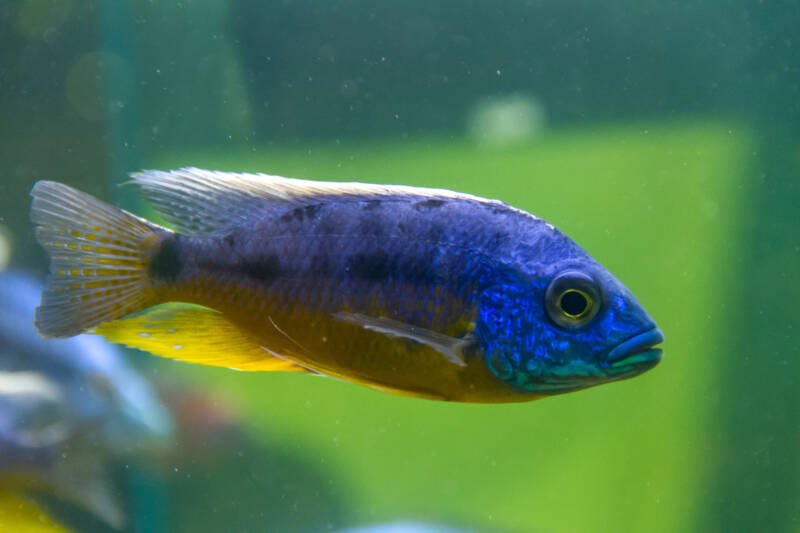
The male Taiwan reef cichlid has yellow, blue, and orange colors and graceful, backswept fins. Females are silver with vertical black bands.
These fish have a milder temperament and can live in a community tank with other species that share similar water parameters.
Just watch the behavior of males around breeding time as aggression can peak toward other males, even those of related species.
Taiwan reef cichlids reach seven inches (18 cm) in length when fully grown.
This herbivore needs vegetable-based cichlid pellets and spirulina in its diet.
They are a mouthbrooding species that can interbreed with closely related species, so avoid placing them with red empress cichlids or related Protomelas species.
Closing Thoughts
With the sheer number and variety of African cichlid species out there, it is easy to see why these fish hold a special place in the heart of so many aquarists.
Whether you are a beginner or experienced, looking for a single species or an addition to a community, desiring spectacular color, or playful personality, there is a cichlid just right for you.
Before you run out and get one, make sure you have done some looking into the species’ needs.
Places of origin have different water conditions, and each species has different temperaments, behaviors, and dietary needs.
These fish are truly special, and you do not want to leave things to chance or take a risk with experimenting.
Set up the proper environment for your fish, provide the appropriate feeding and care, and they will, in turn, give you years of fun!
We have by no means included every African cichlid in our list.
Send us a message below and tell us your favorite (on this list or not)!